Tool · Build
Workbench
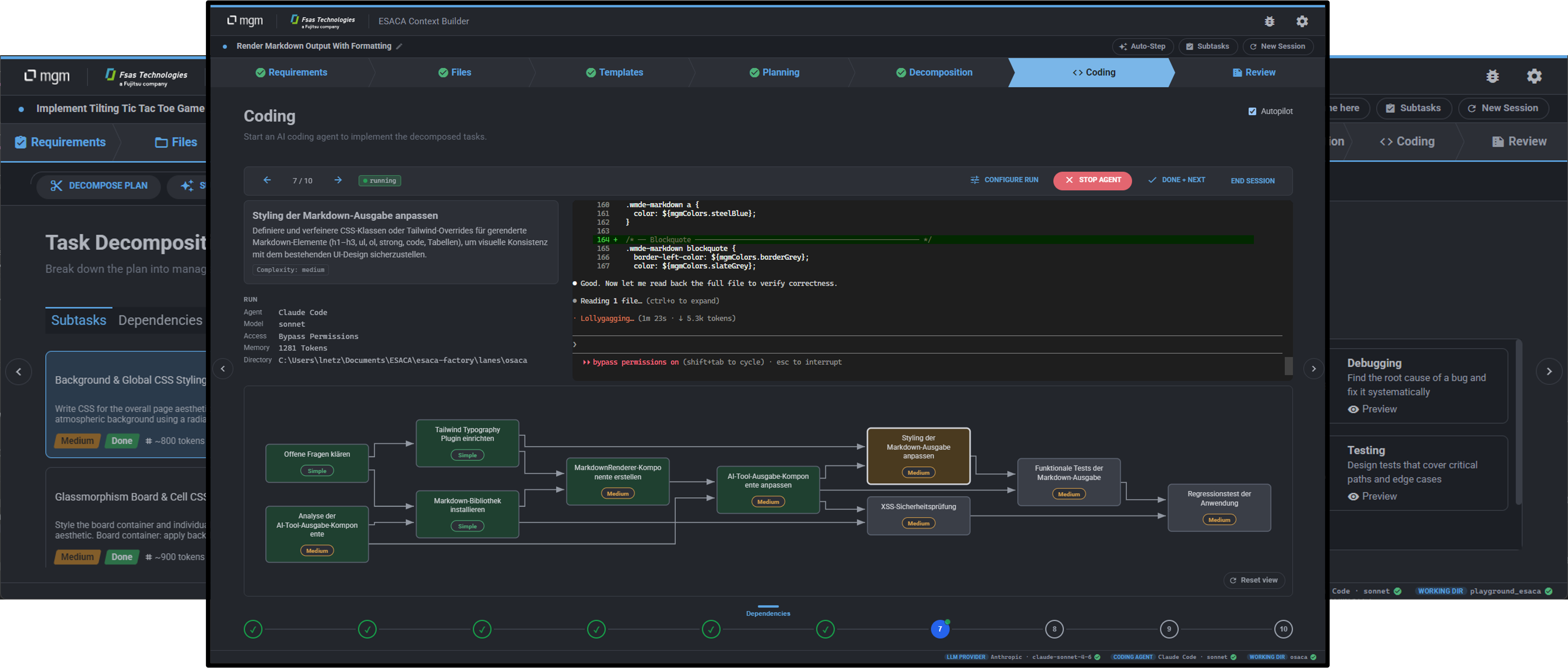
The Workbench is where developers build with coding agents on real projects, on your own infrastructure. It turns a ticket into a plan, runs agents in isolated workspaces, and keeps a person in control of every result.
Capabilities
From a ticket to reviewed, working code
Plan from a ticket
Turn a ticket or an intent into an implementation plan and break it down into concrete subtasks before any code is written.
Multi-agent orchestration
Run several coding agents in defined workflows, each handling part of the work, instead of one agent doing everything at once.
Pluggable agents
Works with OpenCode, Claude Code, Aider and CLI-based agents, so teams are not locked into a single agent runtime.
Multi-repo, pinned state
Work across several repositories at known, pinned commits, so a task is well defined and the result is reproducible.
Isolated execution
Each agent works inside an isolated, sandboxed workspace rather than loose on the host, so it only touches what it is meant to.
Human-in-the-loop, binding
A person stays in control. Agents can propose and mark work done, but the human keeps the override and the review stays binding.
Fits your development flow
Designed to sit alongside your existing Bitbucket and GitLab workflow, with an audit trail of every agent action.
Bring your chosen model
Use the model you selected in the Benchmark. Switch models without rewriting endpoints, on self-hosted or cloud compute.
Workbench · Positioning
For whom — and why
Not a speed tool for vibe coders, but the controlled entry into agentic development — especially with on-premise models.
01 — Beginners
Guided by the hand
Training wheels for getting started with AI — especially with on-premise models, where context and steering are more demanding. It tends to slow the hardcore vibe coder down.
02 — Enterprises
Processes baked in
Good software engineering — traceability, tests before implementation, quality gates, templates — becomes part of the AI process instead of the wild west.
03 — Compliance
Auditable & KRITIS-safe
Full audit trail, managed context instead of uncontrolled on-the-fly loading of skills or plugins — AI hacking is contained, teams work in a standardized way.
How it looks
A loop, not a one-shot
Ticket
Start from a ticket or an idea.
Plan
Plan and decompose it into subtasks.
Agents
Agents work in isolated workspaces.
Review
Review the result, with a full audit trail.
Handover
Hand over to your normal review and merge.
What it gives you
Agentic speed, without giving up control
Traceability & quality, built in
The Workbench bakes testing, quality assurance and traceability into the development process itself. An optimised agentic workflow produces results on your own on-premises models — tested as they are built, and traceable through every agent step back to the original requirements and specifications.